Monday, 29 May 2017

The onomatopoeia of laughter

When the folks at the New Yorker take a break from publishing stories about how spending thousands of dollars on watches is a legitimate form of therapy for Trump-election-induced depression, they feature some good stuff. Case in point, a short piece on "Hahaha vs. Hehehe", in which the author is baffled by, and trying to explore, the emergence of "hehe" as an alternative to "haha".

I will offer my personal interpretation of the different representations of laughter in text in a minute. But first: consider something so obvious that the author of the article does not even question: why do all representations of laughter (besides acronyms) include the letter 'h'? And not just in Germanic languages, but also in Greek, Chinese and, according to my mother-in-law, Arabic (where laughter is apparently represented as just "hhhhhhhh", without any vowels)? (Though different languages obviously use different letters to represent "h"; for example, the Spanish write "jajaja!" - which to me sounds like an overexcited German Shepherd responding to "do you want a cookie?")

The answer is obvious, but fascinating nevertheless: all humans use the same sounds when laughing, and the predominant sound in laughter is that of drawing a breath - which we all instinctively code as an "h". But although all languages (that I know of) have tried to standardise the orthography of laughter in a strikingly similar manner, laughter in real life varies by individual: a professor at Tulane claims that he could transcribe and then read back his friends' laughter with such accuracy that everyone could guess whose laughter he was reciting. That is not to say that individuals' laughter is invariable: it does change, to convey different levels of amusement or other emotions. Nevertheless, it seems that an individual's laughing patterns are quite unique. This observation in itself is moderately interesting, but hardly breakthrough: upon reflection, we'd all realise that we can recognise our friends by the sound they make when they laugh. But I find it amazing that linguists can actually transcribe laughter in such a way that it becomes recognisable.

Unfortunately, it is too much to expect every person to be able to accurately transcribe their laughter, which is why we resort to a common laughter-vocabulary consisting of the exclamations ha, haha (with "ha" potentially repeated a few more times; the reason I called out the single "ha" separately is that it can have a markedly different meaning, as I will discuss below), hehe, heh, hihi, hee hee, tee hee, ho ho, the prefixes mwah, bwah &c, the acronyms lol, rofl, lmao &c and various emoticons.

Of these, "ha ha" is the undisputed king, followed by heh and lol, according to Google Ngrams. All others are less popular:

Do note, however, that Google Ngrams tracks the appearances of a word in books, whereas emoticons and acronyms are far more popular online. Furthermore, the results above are not perfectly accurate, as some writers do not inject spaces between consecutive "ha"s or "he"s; I chose to ignore this in order to eliminate noise from "haha" or "hehe" being used in different contexts (I discovered that the Hehes are a tribe in Tanzania, for instance). Finally, some noise still remains - for example, "lol" also stands for "lots of love".

I therefore tried to validate these results by searching for these various words in my whatsapp chat history. Sadly, the search function doesn't give the number of hits, but eyeballing the data, I'd say that "haha" is indeed the most common, followed by "heh" - although the latter seems to be used almost exclusively by me. There are a few "lol"s, "hehe"s and various emoticons, but no "hee"s, "lmao"s or "rofl"s. Let's now look into these exclamations/acronyms/emoticons in more detail:

Ha
The author of the New Yorker article writes that "ha" is the basic unit of written laughter; that's true, inasmuch as the syllable "ha" is a constituent of "haha", but it's misleading: "ha" on its own is not actually used to express laughter or even amusement so much as surprise, suspicion, triumph &c (according to Oxford Dictionary). The word has its origins in Middle English apparently, though the dictionary doesn't give any sources.

That said, it's true that "ha" is also used for laughter. Well, sort of. I think most people use it as an acknowledgment that something intended to be amusing was said. The prankster who has so far tricked the CEO of Barclays and the Governor of the Bank of England uses it (in character) to applaud his own humour/cunning:

"If you ask for the crystal glasses you’ll be able to admire [the waitresses'] enchanting dexterity. I keep those glasses low down, ha! You don’t reach my age without knowing all the tricks." and

"What else would Mack the Knife do but support those he can trust in!
Begs the question, who should we seek to silence next!?
Onward, to bigger, and better things.
I may have already had a stiff one, it’s been a long day, and I get no younger.
Clapton has nothing on me ha!"

(To me, this usage seems so idiosyncratic that I am surprised that it by itself didn't give away the fact that the emails were a prank.)

Haha (& so on)
"Haha"'s preeminence is confirmed by Oxford Dictionary, which redirects queries for "hehe" to it. According to the dictionary, "haha" is first recorded in Old English, though again, there are no examples (apparently it appears in Hamlet, though it seems that it's actually meant to express surprise instead of laughter). Also, note that Garner says "ha-ha" is the correct spelling.

In accordance with both the Ngrams results and the OED, most of the people who responded to my question on facebook on what words they use to express laugther said that "haha" or "hahaha" is their preferred choice. In their words, "hahaha is more expressive, whereas the other ones are too descriptive", and "the number of consecutive 'ha's is proportional to the volume of laughter".

(One exception: one friend said he uses "hahaha" when laughing at people, and generally seems to attribute a mocking tone to "haha".)

Personally, I use "haha" when only mildly amused, and "hahaha" when I find something genuinely funny. A quick search of the term in my family's whatsapp group (aptly named "Bantercats") reveals that "hahaha" is the most common variant, followed by the standard "haha". There was also a "hahahahaha" from my brother in response to this picture of a hotel room in Tianjin:


(I was put up at that hotel after my flight was cancelled due to bad pollution (that's a thing that happens here) - I pulled the curtains to look outside and found out the room had no window. I don't think they understand the function of curtains in that hotel.)

Heh
Urban Dictionary defines "heh" as "half-laugh, semi-cynical connotation, used on IRC by those too cool to say lol or roflmao". (Here's the word's self-proclaimed inventor.)

I use "heh" to indicate a drier sort of amusement than "haha"; a more detached kind, perhaps, or even slightly patronising (for example, I used "heh" in response to being told that the Chinese call Plato "Bolatu").

At other times it serves as a neutral response. In these cases, it serves to let my interlocutor know that I've seen their message, and that I am well-mannered enough to respond, without actually putting any effort into my response.

Interestingly, the New Yorker writer says that "heh" may have some down-home vulgarity undertones. I had never interpreted it this way, but David Foster Wallace does use "heh" in Brief Interviews with Hideous Men to transcribe the conspiratorial and sleazy banter between two men, one of whom has taken advantage of a vulnerable woman's grief to sleep with her. So I suppose there is something in this view.

Finally, "heh" is used to represent sinister laughter in some comic books, e.g.:


Hehe
Again according the UD, "hehe" refers to muffled laughter, with a sneaky aspect to it. Indeed, everyone seems to attribute similar characteristics to it - my facebook friends assigned "tongue-in-cheek" or "snigger" tones to it, and this academic article says that "hehehe" is a "cynical variant of hahaha".

(Searching for "hehe" in my whatsapp messages yields 13 hits. Of these, 11 "hehe"s come from the same person. I wonder what that says about him.)

Unlike the New Yorker writer then, I do not see "hehe" as an alternative to "haha": they serve different purposes. One interesting question though: do the people who use this variant do it consciously every single time? Do they intend to communicate this "nudge-nudge", "wink-wink" attitude? What I mean is, do people think "okay, I want to show I am being cheeky, so I will specifically write 'hehe'", or do they subconsciously write "hehe" because they are feeling cheeky?

It'd be quite something if the latter - it would show that our intuitive understanding of the various undertones in laughter exclamations has been ingrained in us.

Hihi, hee hee, tee hee, ho ho
All of these are far less common variants. I agree with the New Yorker writer that the first three are cutesy, possibly too cute, as she puts it. To me, they look a bit artificial - they give the impression one specifically chose to use them instead of their flowing naturally, and so they can be a bit jarring. In fact, I don't think I've ever seen "tee hee" anywhere except this famous bash.org quote.

(Note that "hihi" is increasingly being used as a greeting instead of as a stand-in for laughter - and that's the definition given by the Urban Dictionary.

As for "ho ho", its most notable variant is Santa Claus's "ho ho ho". It, along with all previous variants, also appears in comic books when the artists want to show that different characters have different laughter:
Prefixes: bwah, mwah
The former of these is used to express explosive or hysterical laughter, but it's not very common in text speak.

The latter is interesting though: it is universally recognised as evil laughter. Up to this point, all variants have been abstractions, or the greatest common denominators, of individuals' laughter. Though simplified, they have been representations of the ways people actually laugh - earnest laughter, cheeky laughter, cool and detached laughter, mocking laughter - these are all real.

But evil laughter? This is the only one that is an invention. No-one is evil in their own narrative; no-one actually says "mwahaha, I will destroy earth and kill billions of people!". Granted, some people are deranged and may laugh while plotting atrocities - but the thing is, "mwah haha" does not have a mad quality to it. So out of all the exclamations we have discussed up to now, this one is the only one that is purely fictitious.

Acronyms
I am going to put this out there: I consider "lol" and its kin to be signs of intellect deficiency. Though I have at times used them myself, they seem to me a less refined version of "heh" (a view shared by the Urban Dictionary, as mentioned earlier).

I dislike them for several reasons. First, they have lost their meaning: "lol" is supposed to mean "laugh out loud", but no-one interprets it this way - as a frequent user of "lol" wrote on facebook, "[if I actually laugh out loud] I say 'literal laugh out loud'". And no-one literally rolls on the floor laughing, and I am not sure what "laughing my ass off" is even supposed to mean. So it seems to me that using "heh" is more sincere.

Second, "heh" is easier to read, process and interpret than "lmao", "rofl" and even "lol", with which older people are unfamiliar:
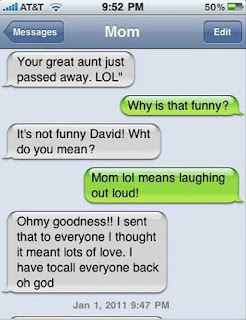
Third, "lol" especially is often used a neutral filler - for example, "I am not sure what to have for dinner lol". Fillers such as "like" are bad enough in speech; we shouldn't be introducing them into prose. They serve no function that cannot be served more elegantly, and more considerately for the reader, by other means.

For one thing, "lol" makes the writer come across like a prepubescent boy; for another, sentences like the one above (which are sadly quite common) are hard to parse: the reader expects the sentence to end at "dinner" but is then confronted by an unexpected word, without any punctuation. This is taxing and unnecessary. Writing badly due may be excusable; doing so on purpose is not.

Emoticons/Emojis
First of all, I must confess I did not know the difference between emoticons and emoji. Apparently, the former are textual representations of smiley faces (or other things) - e.g. :). Emojis are actual pictures - e.g. 

Given the plethora of different emoticons/emoji, it is easy to find one that perfectly fits the writer's intended purpose, and so there is less ambiguity than there is in, say, using "haha" vs "hehe".

My personal take on this increasingly popular form of prose is that emoticons are, generally speaking, good and emojis bad. Emoticons are useful: they are a quirky way of efficient, speedy communication. If you have dinner plans with a friend, and they cancel because they caught a cold, you can send a sad face - :(. This expresses your sadness that they are ill and that you won't see them more efficiently, and perhaps more kindly, than a "oh man, bummer" - which may come across as having slightly accusing undertones.

They also slightly enrich language. When someone at work thanks you for something, or compliments you, you can respond with :D, instead of writing "no problem" (boring), "you're making me blush" (silly) or "oh I'm not that great" (falsely modest).

Emojis serve the exact same purposes, but they are, in their vast majority, unbearably ugly. Look at gtalk's latest crop of smiling faces:


Look at them! They look like melted blobs of cheddar. They are horrible. Facebook's aren't much better either. Furthermore, they are jarring when inserted in text. Emoticons are way less invasive and annoying. What really bugs me is that most apps now automatically translate emoticons into emoji. Meh.

Usage guide
Anyways, to recap, use:

  • "ha!" for surprise or for pranking British bank CEOs.
  • "haha" for laughter, and add more "ha"s in proportion to the funniness of the thing you are responding to. If what you are responding to something unexpectedly hilarious, you can add a "bwah" at the beginning;
  • "hehe" when you're being cheeky;
  • "heh" when you want to acknowledge receipt of a slightly amusing message or if you're a comic book villain;
  • "hihi"/"hee hee"/&c when you're intentionally being cute, but bear in mind that it may come across as artificial and overdone.
  • "ho ho ho" if you're Santa Claus/writing a Santa Claus story (and are not feeling adventurous enough to change his laughter);
  • "mwah ha ha" if you're drawing a comic book villain. But bear in mind this'd imply a simplistic view of good and evil.
  • A combination of the above if you're a comic book artist drawing several characters laughing at the same time;
  • emoticons to enrich your prose - but do not overuse. It's good to be able to express yourself in a variety of ways; over-relying on emoticons may cause a decline in your ability to do so.
Do not use:
  • "lol" and other acronyms;
  • Emojis.
I hope this helps!


Friday, 12 May 2017

Ithaca

Cavafy's Ithaca is one of the, if not the, most celebrated and well-known Greek poems. Like the rest of his poems, part of its universal appeal is, I think, that it is straightforward and accessible without being trite or overly simplistic.

The poem's main message is that the journey is more important than the destination. But the secondary message, explicitly stated by the poem's narrator, is that Ithaca serves a paramount role as a destination: "without her you would not have set out". This second message is often overlooked: because one of modern society's most common afflictions is focusing too much on an arbitrary goal only to find out that achieving it doesn't really bring happiness, most people refer to the poem to remind themselves that the adventures on the way to Ithaca are more rewarding that the arrival on the island. The problem of not having an Ithaca to long to reach is less prevalent.

But I think that with the progress in AI research, we need to start paying more attention to the poem's penultimate verse. Thinkers and journalists are (rightly) highlighting the dangers of increasing AI-led automation, but important though this discussion is, it pales in comparison to the questions that face us if we manage to build super-intelligent computers.

Imagine a world where AI solves the problem of scarcity. It is so intelligent that it not only fully automates all jobs, it not only fully optimises production of goods, but it can event invent new raw materials if the ones available in nature are not sufficient. All goods are free - food, clothes, yachts, you name it. No-one needs to work anymore. Money stops existing. (As an aside, this world does pose a serious challenge: what do we do with unique goods such as land or works of art? Since no-one can offer their labour in exchange for such goods, how do those who did not own any possessions at the advent of this world acquire such unique goods? If you thought today's world is unfair to the poor, let me tell you, there might come a time when you will wish capitalists could exploit your labour.)

Moreover, this AI can not only cure diseases, but also reverse aging. It can connect humans' brains to the internet - no longer to look up anything on your phone, it's all there in your head. No need to study: you can just download all information you need, a la Matrix. It can modify our genes at conception so we are all born with genius-level intellects and Apollonian/Aphrodisian bodies.

No more heated political debate: political division has two factors, imperfect knowledge and scarcity. Since these two are now overcome, we can finally live in peace. No war, no famine, no poverty (assuming we find a solution to the aforementioned unique asset scarcity problem). No suffering, no misery.

But also, no Ithaca: no opportunities for heroism, self-sacrifice, hard work, toil, perseverance. Virtues such as honesty, charity and humility become irrelevant. Our motivators - desire for wealth and legacy, fear of death, competition - become obsolete. We won't be able to relate to our past art - regardless of how much the world has changed, the themes in ancient tragedies, myths and epics are as relevant now as they were at the time these tragedies &c were written. This will be a world where Odysseus never leaves Ithaca in the first place; worse, a world where he not only never leaves Ithaca, but starts importing lotuses (somehow convincing the lotus eaters to stop munching their fruit for a minute and trade).

What will a word like this look, or rather, feel, like? It is a world that is for all intents and purposes unimaginable to us. For thousands of years, we humans have had Ithacas to go to. What happens when these Ionian islands are taken away from us? I don't know - but I find it scary as hell.

EDIT: my brother pointed out that it looks like I am arguing there will be no journey, not that there won't be an Ithaca. It's true that the metaphor isn't perfect - I guess what I am trying to say is that as there will be no journey because there won't be a need to strive for anything.

Wednesday, 3 May 2017

My problems with Hollywood - Pt I

I started writing this post intending to moan about Hollywood's recent lack of originality, and its studios increasing proclivity to produce sequels and spin-offs instead of bringing new scripts to our screens. But while writing the first sentence, it occurred to me that I may just be acting like a grumpy old man: you know, looking at the past with rose-tinted glasses, going on about the "good old days", even though these "good old days" may actually have been worse than today.

So I did what a decent data geek does: I built a database of the top 10 box office hits for each year from 2017 going back to the 1920s, and crunched the data. You can read about how I built the database, and access it yourself, here. My conclusions:

Hollywood is relying more on sequels...
Here is the % of top 10 films that are original scripts by year (note that "original" here excludes not only sequels and spinoffs but also remakes and adaptations - refer to the link above for details on how I classified the films in my database).

And most original scripts since 2010s are animations. In the 00s, 37% of original films were cartoons; in the current decade, the percentage is 67% (the only original top 10 films of this decade have been Gravity, Inception, Maleficent, Ted and Get Out, though the latter's only included because it is in 2017's top 10 so far.). Not that there is anything wrong with cartoons - many are exceptionally good; but it would be nice to have some original live action films every now and then.

(Of course, it could be that if we looked at the entire set of films produced instead of only the box office top 10, the % of original scripts would be much higher. In fact, given that it is becoming increasingly easy for wanna-be director hipsters to shoot indies, I'd expect this to be so; it may also be that big studios themselves are producing more original films, and it's just consumer tastes that have changed, propelling sequels to the top 10. But I doubt this; I think the studios put the bulk of their resources, both in terms of production and marketing, behind sequels.)

For the record, here's how the other types of films (remakes and adaptations) have fared:


... and it's not really making much sense to me
When I thought of writing this post, and before doing the data analysis, I was planning to make some wishy-washy statement about how, yes, sequels are more profitable and all, but oughtn't Hollywood care about artistic merit too? (Which, wishy-washy or not, is something I genuinely believe.)

But since I got the data together anyway, I decided to look into how much more profitable sequels are, compared to original scripts. The answer is, actually, they are less profitable:


(ROI here is calculated as (Revenue/Budget - 1). Both budgets and revenues have been adjusted for inflation to reflect 2017 prices.)

As you can see, the average original film has a far lower budget than sequels, but roughly the same revenue - and a higher IMDB rating. Now, it's true that these numbers are a bit skewed by one-off massive successes - in particular, the reason the non-weighted average is so high for original films is the Blair Witch Project, which had a tiny budget (~$100K) but proved to be a massive box office success (~$240 million). So I included the variance here: this is a measure of the extent of divergence in the data; the higher it is, the more diverse the values in the set - hence, variance is used as a measure of risk.

As the table shows, though sequels are less profitable than originals, they have much lower variance - in other words, they are a safer bet. Or so it looks at first glance: I also ran the data excluding the top 20% of box office hits - hence taking out of the picture once in 100 years outliers like the Blair Witch. Yet here again original scripts beat sequels:

This analysis is incomplete, however, because it suffers from survivor bias: what is says is that amongst films that made it to the top 10, original scripts outperform sequels. What about those that didn't? Like before, it may be that looking at the entire set of produced films would yield different results. Still, this indicates that if Hollywood executives placed more emphasis on discovering good original scripts, and marketed them well (not like they did, say, with the Nice Guys, which was an excellent film that no-one watched), they might do a service to their shareholders as well as to their consumers.

Higher budgets do not translate to better films
First I looked into the correlation between a film's budget and its IMDB rating. It's non-existent. Then at the correlation between a film's budget and its revenue - after all this is what an executive will be interested in. Again, non-existent.

Looking at the same correlations but only for sequels and spinoffs, I find that they are slightly stronger, but still not significant. So then I looked at a few recent franchises to see how their budgets, ratings and box office performance have evolved, all with the objective of answering the question, is a higher budget worth it?

The answer varied depending on the franchise, from kinda...

F&F films have maintained a remarkably consistent rating, but have been peforming increasingly well at the box office (the reason for the dip on the chart on the right is because the latest installment is still in theatres).


The Dark Knight films have also maintained a high rating and have performed well at the box office - though the significant increase for the third installment did not translate to higher revenue, nor to better score.

... to the no:


All these franchises have increased budgets vs the original, yet seen consistent or declining scores and revenues.

... to the God no:


With the exception of Jurassic World, these franchises have seen significant decline in ratings and box office performance in spite of budget increases vs the original.

The one interesting outlier: Mission Impossible has had lower production budgets for the last two installments vs the first and the previous ones in the series, but these have been better received by the viewers. Weirdly, however, they have not performed as well in the box office:

So looking at this data, if I were a studio executive, I'd really challenge my directors to explain why they want more money, when earlier productions had both higher artistic merit and better financial performance.

Having established that Hollywood is failing to produce original films, and that they are not particularly good at managing their money either, and given that I had already gone through the trouble of building a film database, I thought to have a look at a few other trends. Here are a few resulting observations:

Films are worse now than in the 60s
It is not just I who is looking at the past through rose-tinted glasses: older box office successes have a higher average rating than more recent ones:

Unfortunately, my database has a very low number of films from before the 60s, which is why these early decades have such a high average. But still, the 60s have a decent sample size, and a higher rating that recent decades.

Looking at the top 3 films for each year, it looks like earlier decades had higher average earnings too:

I imagine this is due to consumers' having more choices these days.

The highest grossing genre is animation; the highest rated is drama


Horror/Thriller, appears to be the most profitable, even excluding the Blair Witch project. Romantic films are the least popular (probably because Twilight falls into this category), followed by comedies. These probably explain the decrease in the % of comedies, and the increase in animation films:


Strangely, though, dramas are also decreasing, even though they are well liked and the second most profitable (though they do not make big box office hits).

The average film runtime has fluctuated widely through time
A few years ago, I watched a film with a friend, after which he commented: "man, that was too long. I swear there was a time you could watch a flick in an hour. Now everything seems to be two hours long". It turns out he's right: films are longer than they were in the 80s, but shorter than they were in the 50s:


As it turns out, longer films are perceived as being better, though this may be because old films were longer, and as we saw earlier, older films have a higher rating:

In summary: Hollywood is pretty broken; it may be that it needs a Moneyball solution - which would help bring some better stuff to cinemas. It would be interesting to compare films to TV by the way; it seems to me that the quality of TV (and Netflix/Amazon/&c) series is getting better and better. 

A few decades ago, excellent programmes like Freaks and Geeks and Firefly were getting cancelled due to low ratings; but I think we will see fewer cult series getting cancelled in the future. A TV station can only broadcast 24 hrs of content per day, and even fewer profitable hrs; so a niche show with few viewers will get axed in favour of a (perhaps blander) one that would appeal to more people. Imagine that viewers' preferences are represented by the following Venn diagram:
The big circle in the middle represents the number of people who watch a mainstream series, like Friends. The smaller circles represent more niche shows. These shows may be profitable - i.e. their ad revenue may exceed their cost of production; but a TV channel will just rank them by profitability, and will fit in as many of the ones at the top of the list as it can in its schedule.

Netflix by contrast will produce any series that's profitable (more or less, it also needs to take into account its cost of capital &c, but let's keep things simple here). It may still be the case that some excellent shows will never get produced, because they appeal to very few viewers; but it's certainly a better deal for the consumer than TV and cinema.

So perhaps we can (have to?) place our hopes for art on what was once seen as the lowest of the lowbrow entertainment media. At least until a Hollywood exec reads this and says "you know what? Screw sequels".

Film Database - Technical Details

You can find my database here. It consists of a raw data tab (DB), a pivot table that makes it easy to look at the data, and some back up tabs.

To build it, I first went to boxofficemojo.com and downloaded copy-pasted the top 10 film details for every year from 2017 to 1980 onto the Excel file (e.g. here's the link for 2017). Since this only goes back to 1980, I then went to the All Time Domestic box office site, sorted the data by year, and copy-pasted all films going up to 1980.

(This creates a few issues, because it becomes harder to do like-for-like comparisons before the 80s. For instance, 1972 only had 7 films that made it to the all time box office records, whereas 1974 had 17; this means that it's harder to compare the 70s to the 80s, which only feature top 10 films).

Thankfully, copy-pasting from boxoffice.com made it easy to extract the URL for each site - this I put in column B. A formula gets the search link for the film's site in IMDB.com (columns E&F). This is where things get tricky: I needed to be able to extract some basic information about the films. To do this, I used importXML formulas on Google Sheets. What these formulas do is they go to the specified part of a webpage and get the data that's located there. The database at the link above has the results copy-pasted as values, but you can see formulas in the tab "Import Formulas", in case you want to reapply them. The same formulas are used to get IMDB ratings and a few other bits of data.

A few more formulas convert the information thus extracted to an analysis-friendly format. These are relatively simple if you're already familiar with Excel, so I won't go through them.

I adjusted all financials to 2017 $ values to account for inflation. To do this, I used the adjustment table found here. This was missing a few years, so I added those myself by either keeping the same price as the previous year or taking the average between the previous and subsequent year (I did this when these two prices differed significantly).

BoxOffice.com had 99 genre classification combinations, because some films belong to more than one genre (e.g. Action Thriller, Action Comedy &c). I mapped these to 8 genres for analysis purposes. In general, I tried to do the mapping by deciding which single genre best defines a multi-genre film. For instance, Lethal Weapon is correctly classified as an Action Comedy by BoxOffice.com; but if I had to choose one genre only, I'd go for Action. You can find the mappings in the "Genres" tab, though note that I did manually adjust the classification of a few films (so, for instance, Alvin and the Chipmunks' full genre is Family Comedy, which would normally map to Comedy, but I manually changed it to Animation). Feel free to download the db and change the mapping if you disagree with it.

I also had to classify films into one of 5 types - Original, Adaptation, Sequel, Spinoff or Remake. I did this manually (this was the one part I did not manage to automate). Some films could be considered to be more than one of these (e.g. is the Dark Knight Rises a sequel or an adaptation?). In general, the first of a sequence of films adapted from a novel or play (or any other source) was marked an adaptation, and subsequent films in the series sequels; if a film could be considered both an adaptation or a remake, the classification depended on how similar the new film was compared to the previous adaptation. For instance, the Amazing Spiderman was tagged as an adaptation, whereas Ben Hur as a remake (though to be fair, I've only ever watched the Charlton Heston version - but since the film is usually called a remake, I went with that).

I think this pretty much covers it - but feel free to ask any questions in the comments.

Thursday, 23 March 2017

27 Years of Solitude...

... or 27 years of internet (counting as of 1990, when Tim Berners-Lee created the first website).

A week ago a friend sent me this article which claims that technology is useful for solving problems of "matter, energy, space or time" but not "human problems of the mind". It goes on to say that technology does not actually connect people but is merely a medium through which people communicate.

I wasn't going to write about this, but for my latest Chinese homework assignment, my teacher asked me to write a paragraph on "what if there were no internet". This was a very frustrating assignment because my vocabulary is nowhere near good enough to express concepts such as "loneliness", "human interaction", "humblebrag", "narcissism" &c. (The only word in this list I know knew how to say in Chinese is "&c" (I have since learnt "loneliness").) So I'm writing this to vent the built up frustration (some people go running for this purpose (i.e. for the purpose of venting frustration in general, not frustration that results of an inability to express oneself in a foreign language in particular); I hate running. I once trained to run for a race, and hated every minute of it. Hollywood has since tricked me into trying it a few more times, and every single time, five minutes in, I start thinking how much happier I'd be just walking. Which is what I end up doing - but then I think how much happier I'd be walking in normal clothes rather than a decade-old sleeveless t-shirt I got for a pub crawl back at York).

Back to the matter at hand: the author of the aforementioned article touches on an interesting (yet by no means original) point when he says that platforms like facebook actually exacerbate a need for connection instead of sating it; but, as I told my friend who sent me the article, I found the author's arguments shallow and pedantic. They (the author's arguments) are flawed from the get-go, because he (the author) cavalierly asserts that technology does not connect people, without explaining what he means by the term. Since he acknowledges that technology makes communication easier, he clearly doesn't use "connect" in its standard definition, which is to bring into contact.

But for all but the most exotic and abnormal definitions of the word, connection surely relies on, or at least is enabled by, communication. If technology therefore enables the latter, it also enables the former. It doesn't matter whether technology directly forms "connections" between humans (and in fact, it'd be weird if it (technology) or anything else for that matter instantly formed deep bonds between people (and I for one have always found facebook's "you are now friends with..." absurd: what, was my friendship's status with that person unconfirmed, and required fb's stamp of approval to become official?))

Unless of course there are qualitatively different forms of communication, some conductive towards building bonds, some not. The question then becomes, which kind of communication does technology foster? There are two ways to answer this question. The first is theoretical: we can try to determine what are the characteristics of the former kind of communication and see whether technologically-enabled communication posses them. Or we can answer the question empirically by asking people whether they feel more connected to others through their use of technology. This second approach is way easier. Now, the [work required to answer this question] to [my interest in getting an actual answer] ratio is very high in this case (as indeed it is in most cases because I'm lazy), but anecdotal evidence re the number of persons who form friendships through their interaction in IRC/forums (fora? too pretentious?)/Wikipedia/World of Warcraft/9gag/other platforms and who I believe would report having formed solid connections with people they've never even met in real life (e.g. see here for an example of a man who left his real life wife to marry his Second Life fling whom he'd never actually met in person) suggests that technology does in fact help foster deep bonds between people.

But because thinking things through is both more fun and less taxing than actually doing work (which is, I suppose, why there are so many armchair revolutionaries/caviar leftists/champagne socialists), let's try our hand at the first approach: let's try and imagine what communication that helps form profound bonds between people looks like (undetermined: the reason I sometimes use the plural pronoun and sometimes the singular one in my blog posts). Note here that I base the following on absolutely nothing empirical/scientific.

Working backwards, I would define a meaningful connection between two persons as a relationship characterised by mutual respect, affection and understanding. What we need to do now is understand how these feelings develop, and what sort of communication would foster their development; all we need to do then is make an argument as to whether technologically-enabled communication is the sort of communication that does so.

Mutual respect arises (I will avoid inserting "I believe"s and "I think"s - discount the matter-of-fact tone appropriately, as if I had (inserted these disclaimers of subjective opinion)) in two cases: a) when people share a value system and b) when each side believes the other side would stand up for their value system (even if this a non-shared system) even in adverse circumstances. For example, a lot of liberals strongly disagree with many of John McCain's positions and values; yet it is impossible not to respect a man who refused early release from a Vietcong prison where he was being tortured because of his belief in a military Code that specified POWs should be released in the order they were captured.

(To anticipate an objection here: some readers may suggest that respect also arises in cases of "success" regardless of values; I dispute that. Take a hypothetical example: some people think Travis Kalanic, Uber's CEO, deserves respect for his success even though he is, by all appearances, not a very nice person. But I think the people who would argue this are just balancing his ruthlessness with other values, such as ambition and drive, in their worldview; so values do come into play. You would never respect someone if they literally have no values in common with you, regardless of their success (except see (b) above).)

Affection mainly arises through sharing positive experiences. Understanding between two people develops through each one getting to know the other - the more intimate and personal the information shared between two people, the stronger the understanding (and probably the affection) between them.

So for two people to form a meaningful bond they need to spend a lot of (good) time together, get to know each other's principles and (honestly) share personal information with each other. I would argue that technologically-enabled communication meets these criteria. As you probably know, there are tens (if not hundreds or even thousands) of flourishing online communities of people who spend the majority of their time on their screens. There are people who identify with their online avatars to the extent of holding online funerals for people who die in real life (and jerks who stage raids on said funeral processions); people who pretend to be citizens or rules of digital micro-nations (and who take micro-nation politics seriously enough to spend real-life years infiltrating each others' nations to wreak havoc); people who create online corporations that pretty much work like real-life ones; and even nations that have created virtual embassies.

Now all these people certainly spend enough time with each other to develop feelings of affection - in fact, I guarantee that there are people who feel more affectionate towards friends they've made online and that they've never actually met than towards people they know in real life. It's also easy to argue that people will cluster together with others who share their values - given that online you have absolute freedom of choice with regards to whom you hang out with, it is more than likely that people will choose to associate with those who share their worldview.

The only debatable aspect is the genuine understanding and knowing between people. Some will argue that online communication is more likely to be dishonest: after all, OKCupid has shown that people online lie about how tall they are, how much money they make or even their sexuality. And we all know people whose online persona is more glamorous, more care-fee, more happy than they are in real life (I will revisit this point further down).

Yet I would argue that in some cases people are more honest online than they are in person. Anonymity (and temporal limitations) means that you can say whatever you like without a group of people forming a circle, pointing their fingers and laughing at you; the fact that you can seek new communities and groups of people at a click of a button means you can shed all your defenses, you can risk being vulnerable - and if people accept you in this state, you will feel closer to them; if not, you will just try your luck with another group. I am sure there are online communities of people whose members know more about each other than you (the reader) know about your close friends (spend 10 minutes on bash.org and you'll see how forthcoming people can be). One counter-argument here is that in many cases, people in such communities do not even know each other's real names; but without wishing to get too philosophical here, I'd say, why does that matter? If these people project their most raw, real personality online, and each one gets to know each other's character, don't these people form real bonds?

So I think there is a solid case to be made that technology does enable the kind of communication that builds genuine relationships. A good relationship is one that helps people escape their feeling lonely; and I genuinely believe there are thousands of people who feel less lonely because of their online interactions (consider also the myriads of blogs available: I can only think of two reasons for a person to publish their writing: a) they are incredibly arrogant and think what they have to say has 1) never been said before or 2) never been said as well as they can say it; and b) they are trying to connect with other people by sharing their thoughts (this category includes those who hope people reading their writing will satisfy their vanity). I'll leave it to the reader to guess to which category I belong, but surely a huge number of blogs exists for reason b, and (I hope) some of these blogs really do help their authors feel heard and understood).

But all this said, I do agree with the article's author that there is also a case to be made that technology exacerbates loneliness rather than combating it. This happens when people seek to misrepresent themselves. I do not need to expand too much on this point because it has been captured brilliantly by Black Mirror and Wait But Why; briefly, my own take is this: people get caught in a vicious loop of making themselves appear better looking/more interesting/fun/happy online than they are in real life. But then of course they feel they have to keep up with this image, so they spend more and more time curating their online profile than experiencing the things they are so meticulously documenting. I swear there are people visiting museums or other sights and only see the works of art or monuments or whatever it is they are looking at through their screens; in which case, what's the point of visiting the place in person? The point of course is that you then get to post the picture online so all your friends know what an exciting life you live. But the more you do this, the more lonely you feel, because you know that all these people who see your profile do not see the real you; do not see your sadness or your problems or your insecurities; they don't know you. So you feel more alone than you would if you didn't have this brilliantly maintained profile. Also, there is this other thing: you "like" other people's photos, not because you genuinely like them (I mean, honestly: does anyone, anyone, feel a genuine, positive emotion at seeing another person's dinner?) but because you expect reciprocity; and then whenever someone "likes" your stuff, you have this nagging thought at the back of your head: do they really like it, or is it just part of the game between people? (On the matter of reciprocity: its most shameless manifestation is on LinkedIn, where people endorse each others' skills even if they have never worked together. I swear I had something like 30 people to whom I hadn't spoken in years, with whom I had never worked in the same company, much less in the same team, who had endorsed me for "financial analysis" or "strategy"; worse, they would endorse one of my skills one day, then another a few days later - like they were thinking "maybe if I endorse him for a sufficiently high number of skills, he'll endorse me back; I just haven't reached that number yet". I have since disabled endorsements because vain though I am, being endorsed by people who have precisely 0 knowledge of my ability is almost sickening; what this behaviour says about the state of the world is too depressing to fully articulate.)

So in conclusion: technology can be both a cause of and an antidote to loneliness. Which one it is is entirely up to us, the users. If we use technology to talk with people we wouldn't be able to otherwise, if we use it to connect with strangers by being open and honest, we will make the best of it. If we use it to feed our vanity, if we use it as escapism by building an online self that projects our best qualities but brushes the worst under the carpet, we will feel alone. Technology: use with care.

Wednesday, 1 March 2017

Lunch with the FT - Jesus Christ

The Messiah discusses religion as philosophic inquiry, atheism and South Park over sole meuniere in London.

This is the first interview Christ has ever granted, so I arrive at Wilton’s early and excited. Nevertheless, when I am led to a booth towards the back of the restaurant, I find Him already waiting for me. His features are very similar to His portraits (though his complexion is slightly darker) but I wouldn’t recognise Him if it weren’t for His halo: though He has kept the beard (“beards are back in vogue,” he remarks), He has cut his hair, and has ditched the tunic in favour of a bespoke navy blue suit and blue tie with a seagulls motif.

“So,” I fire away, “what do you think of Christianity these days? How has it fared?” Hit and miss, he says, hit and miss. “I don’t like how spineless religious leaders are - very backwards, afraid to make progress. On the other hand, millions of people find solace in Christianity, and many use its teachings to become better people, which is its point in the end.”

A waiter arrives to ask if we would like a drink. I ask him whether he’s tempted by a glass of wine. “A glass?” he replies grinning. “I thought the paper is footing the bill, why not a bottle?” This surprise is welcome, given that most of the FT’s guests these days eschew alcohol altogether. We order a bottle of Pouilly-Fume, and study our menus. We both opt for lobster bisque to begin with and sole meunier for main.

As the waiter retires, I ask Christ what exactly does He mean when He accuses religious leaders of being backwards. In what ways ought they be progressive? He explains His argument is not so much about the Church’s position on any particular topic, but rather its overall dogmatic approach. “You see, Christianity was not meant to be a series of prescriptive rules, fixed for eternity. I mean, yes, sure, I did provide some guidance, but it was not meant to be set in stone - my advice was relevant for that particular era.”

Our waiter returns with our bottle of wine. Christ tries it and motions the waiter to fill our glasses. He continues elaborating on His argument. It turns out Christianity wasn’t meant to become dogma, but the beginning of a new kind of philosophic inquiry. Christ argues that as early as 0 AD philosophy had become the province of academics, an esoteric discipline with little practical applicability. “A few hundred years before then, the common citizenry would discuss the nature of morality, try to draw lessons from it and use it to become better”. This gradually stopped happening, He argues, so he came to the world to try to re-engage humanity.

If that was His purpose, I say, he didn’t quite succeed. “You don’t say”, He responds with a smile. “I tried to get people to think about what makes a person good - humility, kindness, forgiveness - yet the message, simple though it was, got lost.” He claims things are worse than ever now, which is why He is giving this interview.

“I blame our universities” I joke. “And so you should!” he agrees. “Academics seem more interested in producing incomprehensible essays on the nature of reality (without any training in physics, by the way) than in connecting with and guiding the average person.”

As our bisque arrives, I ask him whether this is related to the increase in polarisation we see in politics. “Absolutely, a hundred percent. Look, you have people arguing without listening to each other at all - why is that? It’s not because people are stupid or inherently hateful, it’s because they don’t have a common vocabulary when it comes to discussions on morality. It’s like trying to have a debate at the Cambridge Union where one side argues in Greek and the other in Arabic.” He points out that while academics write five-hundred page books on theories of justice, the average person does not even know how to begin analysing the morality of a given action. “Let me ask you this: suppose person A intentionally shoots and kills person B. Suppose also that person C gets drunk and fatally runs over a child. Are A and C both immoral? If yes, equally so? Well, some people will say yes, others will say no, but almost everyone will make a judgement based on uncalibrated, uneducated intuition.” How would He approach that question, I ask Him. He says one needs a framework, a common framework He stresses, for tackling this issue. “For instance, you could start by arguing any action can be evaluated across two dimensions - intention and efficacy. You could argue that morality is a function of intent only, not result - so, for example, if I say something that offends you, I am only immoral if I meant to hurt you; if I used clumsy language, though stupid, I’m not immoral”.

He hastens to add that this isn’t necessarily the right framework - in fact, He admits, it is demonstrably incomplete, as it can only evaluate the morality of an action, not of inaction - so, while this model is useful for, say, distinguishing between murder and a fatal accident at a shooting range, it doesn’t have anything to say about a driver’s responsibility to not drive when drunk. “But it would be a start,” He adds.

What about science, I ask. How is one to reconcile it with religion? “Science ought to guide religion, and philosophy more generally. As I said, religion was meant to help people reach their telos, to become moral, happy. Scientific disciplines like psychology, or even behavioural economics, offer insights in what makes people happy, or what they perceive as moral. Religion ought to use these insights to evolve its message. But religious leaders, and philosophers for that matter, don’t seem to pay much attention to the latest scientific thinking.”

As our mains arrive, I change topics and ask Him about His dress code. “I thought you advocated humility. How does an Hermes tie fit with that message?” “Ferragamo,” He corrects me laughing and fingering his tie. “I like how playful it is.” He explains that message was misunderstood: “I wasn’t trying to say people shouldn’t enjoy life. Why would Father create all this beauty in the world, and grant humanity the capacity for aesthetic appreciation, if such appreciation were a sin?” What He was trying to get across is that people shouldn’t accumulate material goods driven by greed and a desire to show off; “buy things if they make you happy - and don’t take them for granted!”

I also question Him on religious texts and church services. He says He is disappointed in how His Apostles wrote their Books. “Too dry, no sense of humour. Which is a shame, because in real life some of them were very jocular - I don’t know who decreed that academic, philosophic and scientific texts have to be as arid as the Sahara, but people seem to have equated dullness with seriousness and significance. Again, recall my point earlier about science being insufficiently exploited; it is a fact that humour makes a message more memorable; advertisers have exploited that, but academics? Not so much.”

Does He think going to church is important? “I think taking time to meditate is important, and I think churches provide a great environment for doing so. If, as we discussed, priests used religion as moral inquiry rather than as dogma, church could serve a very important function.” What about other religions? “I think the same criticisms I’ve leveled against Christianity apply. No religion is inherently wrong; ossified thinking and hatred are.”

Having finished our mains and our bottle of wine, we feel too heavy for dessert, so we only order two espressos. I question him on atheism - what is his view of it? He draws a distinction between atheism as an argument against the existence of a deity and as an argument against religion’s moral teachings. “I get rejecting something you cannot prove; but religion as a theory of morality ought to be evaluated on its own merits - if Christianity or Islam help people become better, if their logic is not inherently self-contradictory, why argue that they are invalid as tools of philosophic inquiry?” I raise the point that a lot of people, inspired by religion, cause pain and destruction. Surely, then, atheists are sometimes right to be polemic? “That’s not a fair argument against religion - Stalin killed a lot of people in the name of Marxism, but no-one argues economics is inherently evil.” He pauses for a minute, and then adds chuckling, “okay, some people do.”

As I pay, I ask Christ what He thinks of parodying religion. He replies that there is nothing inherently wrong with it, though it is often done badly - “in which case it’s immoral inasmuch as bad art is immoral”. He thinks comedy is a great way of criticising any concept, “from Aristophanes's comedies to The Book of Mormon - if the piece of work has something to say, and can make people laugh at the same time, I don’t see why I should object to that. By the way - going back to atheism - have you seen that South Park episode on Mormons? It ends with a little Mormon boy, admitting to another character that Mormonism may be silly, but its practitioners are nice people, and he himself is happier than the other inhabitants of the titular town, closing with ‘you have a lot of growing up to do, buddy’ - plus an obscenity. That pretty much sums up my vision for Christianity”.

Sunday, 26 February 2017

Gender Pay Gap

The gender pay gap. It exists. It's a myth. The gender gap being a myth is a myth. Like most divisive topics, the gender pay gap's existential status seems to depend less on data and more on the publication you happen to be reading. And unfortunately, most people are too lazy to actually do some data crunching themselves, regardless of how passionate they proclaim to be about the topic.

I am very lazy myself. But I am also tired of both rah-rah men using a very personal definition of "pay gap" to claim that there is no such thing and hearing of stunts like bars charging women 77 cents for every $1 men spend*. Last week I had a fb debate with a guy who belonged in the former group, and that was the straw that broke the Aris's back. So, I've tried writing a post presenting a slightly more objective analysis than your average Guardian/Daily Mail article on the matter.

Unfortunately, the Office for National Statistics makes it very hard to gather the relevant raw data. For some inexplicable reason, there doesn't seem to be a single database with numbers on employment and wages by gender, occupation, tenure and family status. My analysis is based on the following ONS sources:
Based on this data, I come to the following conclusions:

The pay gap is definitely a real thing
Anyone who denies that the pay gap exists is simply delusional. Now, it turns out most people who say the pay gap doesn't exist do not exactly mean that men and women are paid the same on average. What they mean is that while there is a difference in average wage, this disappears when adjusting for women's employment preferences. This is debatable, and I will discuss it later on, but for this section, I just want to say that if you are the kind of person who says "the pay gap is a myth" when you mean "the pay gap is real but it's not because of direct discrimination", you are really, really annoying**.

Look, I get that "the pay gap is a myth" is a catchier title than "the pay gap is quite complicated". But to change the definition of words in a hunt for more clicks is dishonest. How do you expect to have constructive conversation if you refuse to use the same language as the other side? A feminist who hears you say "there is no pay gap" will (rightly) dismiss you as crazy.

For the record, here are the 2016 numbers:
Women are actually paid more in part-time jobs, but significantly less in full-time jobs, and as 41% of women work part-time vs 12% of men, on average women earn almost 20% less than men.

Note that "average" here means "median". The 2009 paper cited above shows that if the pay gap is calculated using the mean instead, the pay gap increases for both full time and part-time jobs (because there is a small number of high earners, mostly men, who skew the results).

So yes, there is an argument to be made that a significant portion of the pay gap is due to women choosing to work part-time. But even so...

The pay gap persists across almost all professions
Women seem to be paid less even when comparing full time roles in the same profession:

Up to this point, those who are upset over the pay gap have a very good case: women are paid less, and the difference is not fully explained by the type of jobs women go for, nor by their being more likely to work part time. But this is not the end of the story. 

Family Status
The data here is shakier. But what little data I have seems to point to the conclusion that family status is more important than profession or full-time vs part-time status in driving difference in pay.

The first piece of evidence here comes from the 2008 labour market review I cited. The raw data comes from the Labour Force Survey, which is a quarterly sample of 52,000 households in the UK and is self-reported (vs, e.g., collected from employers' data as is the case in the Annual Survey of Hours and Earnings (and btw, not to blow my own horn here, but this is the level of detail you need to get down to if you want to objectively discuss such a loaded and complex topic)), so it's not like we can treat it like gospel (which is a funny saying, given that an increasing number of people treat (treats?) gospels as fiction). Still, what this data shows is that the pay gap not only disappears, but is actually negative (i.e. women earn more than men) when adjusting for marital status:

Furthermore, the pay gap increases the more children a woman has.

The second piece of evidence (and this one from the aforementioned ASHE) comes from the fact that the pay gap by age group shows negligible difference between the pay of men and women before the age of 30 (i.e. the age when most people start getting married/having children):
Of course, there are other reasons besides marital status that could be causing an increase in the pay gap later in life. For example, it could be that because hiring practices are more standardised for entry-level positions in large companies, or because competition for juniour positions drive starting salaries close to the minimum wage, discrimination doesn't really manifest at this stage, whereas it has a progressively larger impact in higher steps of the corporate ladder.

Nevertheless, this piece of evidence bolsters (but does not 100% confirm) the case that the pay gap is driven by women's preferences vs discrimination. By the way, a lot of news sources claim that discrimination accounts for 38% of the pay gap. As far as I can tell, this claim is taken from this study; however, the exact quote from the study is "38% is due to direct discrimination and differences in the labour market motivations and preferences of women" [emphasis mine]. Somehow, most liberals people seem to miss the italicised part of that conclusion.

Conclusions
So, to sum up: there is a pay gap no matter how you measure average earnings; it's consistent across industries; it's diminished when you separate full- vs part-time employees; and it disappears when you adjust for marital status or age.

So what does this tell us? I think it tells us that most people who discuss the issue, on both sides, are wrong. Those who quote the pay gap implying direct discrimination in the work place have a far weaker case than the headline 20% pay gap indicates: indeed, it certainly looks like the pay gap is to a significant extent driven by women's choices.

On the other hand, those who interpret this last statement to mean that there is no work to be done combating sexism are even more in the wrong. Instead of accepting that women choose to not pursue their careers as aggressively as men when they get married, or that women choose lower paying jobs, we ought to ask why this is.

My argument is that even if it's not direct, text-book sexism that is causing the pay gap, those choices women make that lead to the difference in pay are often themselves the result of discrimination and social pressure. I know some men people argue that women make such choices because they are innately less ambitious/more geared towards taking care of a family/poor negotiators &c; while I disagree with this, the fact is it doesn't matter: even if it were the case that most women are biologically less likely to pursue high-powered careers, the fact that society holds back those women who do so is reason enough to make policy changes.

So, in this final section I want to provide some evidence that there is social pressure on women to drop out of the work force, or be less ambitious than men. 

First of all, this study tracks social attitudes towards gender roles, and while it finds that only (?) slightly over 10% of respondents agree with the statement that "a woman's job is to look after the home and family", only 5% of respondents agree that a woman should work full time when there is a child under school age:
(To be fair, the study only surveys a few thousand people; still, it's a pretty strong indication that while most people say that in principle it's no longer solely the man's role to earn money, when quizzed further they still think a woman should prioritise home care).

According to the same study, women tend to do a far larger share of household tasks (e.g. laundry is done always or usually by women in 70% of households, while preparing meals is done by women in 55% of homes and by both partners in 27% of homes). And I am sorry, but there is no way women are biologically hard-wired to enjoy folding sheets.

Then, there's the fact that when women are ambitious or driven, they are considered pushy/bossy/less likeable. For example, Sheryl Sandberg in Lean In refers to the Howard/Heidi experiment, where Harvard Business School students were assigned to study the case of an entrepreneur named Heidi. But the professors changed the name of the protagonist in the document they distributed to half the class to "Howard". Amazingly, though all students rated the protagonist as competent, "Howard" came across as a more appealing colleague, whereas Heidi was seen as selfish and "not the type of person you'd want to hire or work for". So women are told that to be as demanding as men is a bad thing; is it a surprise if fewer of them are willing to risk being seen as selfish?

Furthermore, while it's true that women are less eager than men to negotiate, it seems they have good reasons: women are penalised more than men for initiating negotiations. In one of the experiments in the study none of you will bother reading found at previous hyperlink, women were judged to be 25% less hireable if they asked for a higher salary, whereas men were deemed only 11% less hireable for doing the same. Another experiment similarly showed that there was a significant drop in willingness to work with a woman who attempted to negotiate; the drop for men was negligible.

(Interestingly though, women who did not negotiate were seen as more hireable than men who also didn't. And while subjects were less willing to work with women who tried to negotiate, they still perceived women as less demanding and nicer than men. a) This is very bizarre - so subjects thought that women who negotiate are nicer than men who do, but are less willing to work with them - the hell? and b) funny how liberal news sources that quote this study (looking at you, New Yorker) fail to report these findings.)

And finally the fact remains that many industries and companies still treat women pretty horribly. This is wrong regardless of its effect on pay, and should be addressed on principle.

All this points to the fact that, as I said earlier, there is still lots of work to be done. Recent policies such as requiring companies to disclose the difference in pay between their male and female staff cannot hurt, but they're not sufficient. I think the policy that would have the biggest impact in reducing the pay gap is increasing paternity leave and making it an acceptable career choice for men.

Note that just instituting a joint-parental leave policy, whereby parents would be free to choose how they want to split paid leave between them, would not do (although I personally would certainly welcome it and send my wife back to work while I'd stay at home, reading, watching films and playing video games with take care of our children): OECD data shows that the longer the parental leave, the higher the pay gap.


This is probably because when couples are given the choice of how to split parental leave, most will have the woman take most of it.

No, what we need is fixed, take-it-or-leave-it leave periods for both men and women (e.g. 1-2 months each, non-transferable, so that if the man doesn't take his, it's lost). This study (whose statistical methods fly way over my head) finds that both men's and women's future earnings decrease when they take paternity leave. So "forcing" couples to split the "burden" of raising children would go a long way towards eliminating the pay gap (and interestingly, women's future earnings actually increase (vs just staying flat) when their husbands take paternity leave, while the opposite effect does not occur (though again, my knowledge of statistics is not good enough to evaluate these statements)).

Also, companies should be more understanding of trailing male spouses - P&G is very good at this (they've accommodated two personal requests for me to follow my wife's career), but from what I've heard other companies are more likely to be understanding of women following their husbands than the other way around. 

Finally, male and female staff should learn to track their gender bias (both the study I linked to above and the Heidi/Howard case show that women are just as likely as men to discriminate against other women) when recruiting or managing employees (I for one have built an Excel model tracking all the interviews I conduct to check whether I show any biases. Happy to report I don't seem to have one, at least when it comes to gender:

).

* the reason this kind of thing bothers me is that it's overly simplistic, passive-aggressive and likely to alienate lots of men people. Proponents of such antics claim they are good because they raise awareness. They do not. People will read such articles, have a chuckle to themselves and move on. Those who believe sexism exists will keep on believing it without looking into the details; those who don't will feel annoyed and become more entrenched in their views. If you want to affect change, you need to understand a problem's root cause - and crying out "sexism" without nuance won't achieve anything.

**
Pay-gap deniers' logic & linguistic manipulation applied in other domains:

"There is no such thing as obesity; just people who eat a lot."
"Lung cancer is a myth; it's just that some people smoke and therefore develop growths."
"I am not firing you; it's your own incompetence that means you can no longer work for this company." And so on.